

Measurement of Physical Quantities

What is a measurand (physical quantity), and how does it differ from a measured value and a unit?
A measurand is the physical quantity intended to be determined (commonly referred to in metrology as the “measurand”). Only when it is clearly defined what exactly is being measured – for example, the length of an edge at a specified location, the temperature of a surface at a defined emissivity, or the profile along a laser line – does the measurement become reproducible.
A measurement result consists of a numerical value and a unit; formally, it can be written as:
x = {x} · [x]


You are currently viewing a placeholder content from Vimeo. To access the actual content, click the button below. Please note that doing so will share data with third-party providers.
More InformationWhy is defining the measurement object or measurand the first step in any measurement task?
Every measurement is a comparison. Therefore, it must be clear which property of an object is meant: length at which position, temperature on which surface, profile over which track width, etc. Even small ambiguities in defining the measurand lead to non-comparable results.
In practice, the measurement task, measurement conditions, reference system, and evaluation method are defined in advance.

You are currently viewing a placeholder content from Vimeo. To access the actual content, click the button below. Please note that doing so will share data with third-party providers.
More InformationHow is a physical quantity converted into a measurement signal (transduction), and what is the role of the measurement chain?
Transduction describes the conversion of a physical quantity into an evaluable signal (usually electrical).
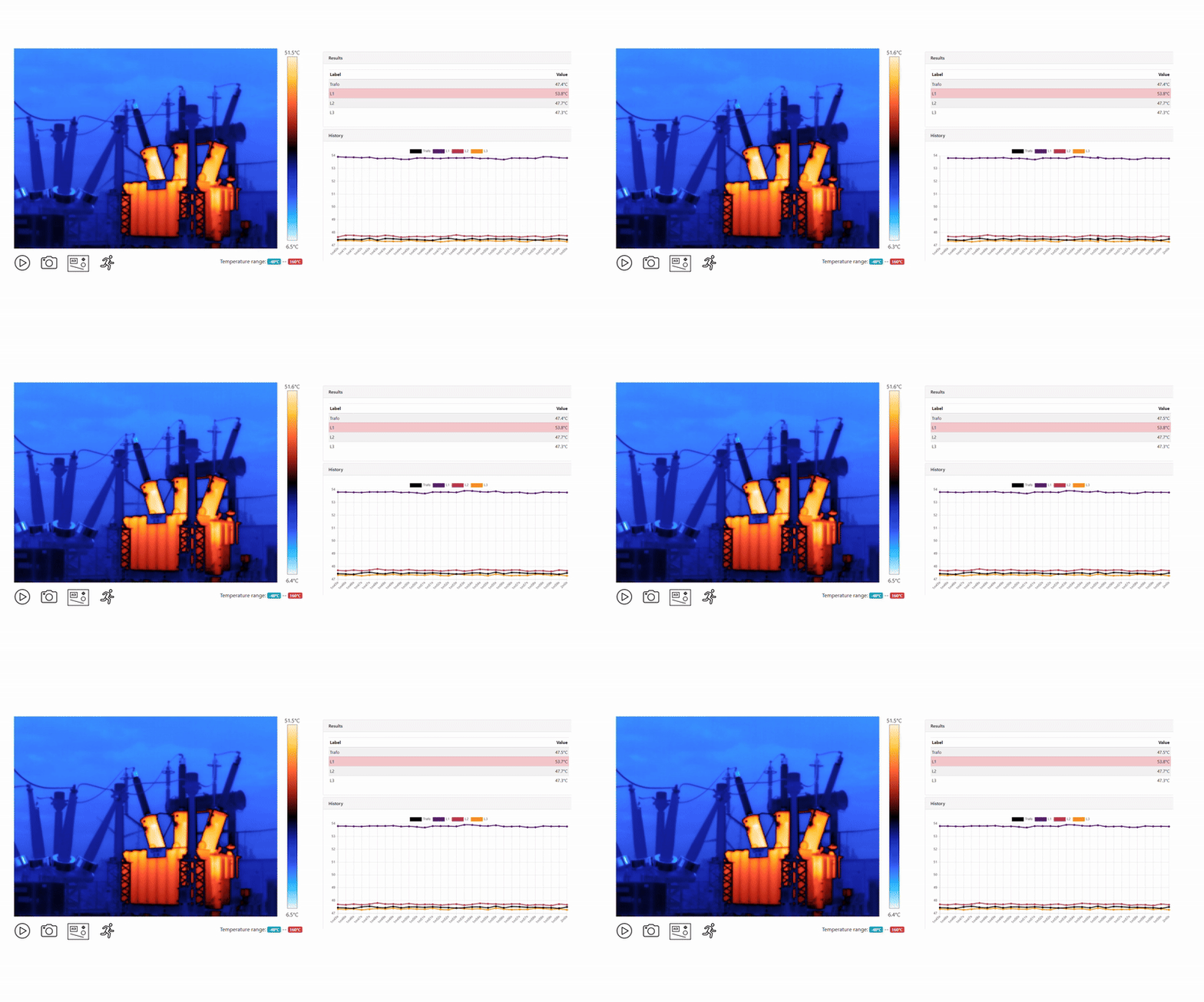
Optical systems, for example, convert geometric information via light projection and camera imaging into pixel coordinates. Thermal systems detect infrared radiation and derive temperature values from it.
The measurement chain includes the sensor, signal conditioning (amplification/filtering), digitization (ADC), evaluation, and, if necessary, compensation. Each element of the measurement chain contributes to measurement uncertainty.


You are currently viewing a placeholder content from Vimeo. To access the actual content, click the button below. Please note that doing so will share data with third-party providers.
More Information