

Messung von Physikalischen Größen

Was ist eine Messgröße (physikalische Größe) und wie unterscheidet sie sich von Messwert und Einheit?
Eine Messgröße ist die physikalische Größe, die bestimmt werden soll (in der Metrologie häufig „Measurand“ genannt). Erst wenn eindeutig feststeht, was gemessen wird – beispielsweise die Länge einer Kante an einem festgelegten Ort, die Temperatur einer Oberfläche bei definiertem Emissionsgrad oder das Profil entlang einer Laserlinie – wird eine Messung reproduzierbar.
Das Messergebnis besteht aus Messwert und Einheit; formal kann man schreiben:
x = {x} · [x]


Sie sehen gerade einen Platzhalterinhalt von Vimeo. Um auf den eigentlichen Inhalt zuzugreifen, klicken Sie auf die Schaltfläche unten. Bitte beachten Sie, dass dabei Daten an Drittanbieter weitergegeben werden.
Mehr InformationenWhy is defining the measurement object or measurand the first step in any measurement task?
Every measurement is a comparison. Therefore, it must be clear which property of an object is meant: length at which position, temperature on which surface, profile over which track width, etc. Even small ambiguities in defining the measurand lead to non-comparable results.
In practice, the measurement task, measurement conditions, reference system, and evaluation method are defined in advance.

Sie sehen gerade einen Platzhalterinhalt von Vimeo. Um auf den eigentlichen Inhalt zuzugreifen, klicken Sie auf die Schaltfläche unten. Bitte beachten Sie, dass dabei Daten an Drittanbieter weitergegeben werden.
Mehr InformationenHow is a physical quantity converted into a measurement signal (transduction), and what is the role of the measurement chain?
Transduction describes the conversion of a physical quantity into an evaluable signal (usually electrical).
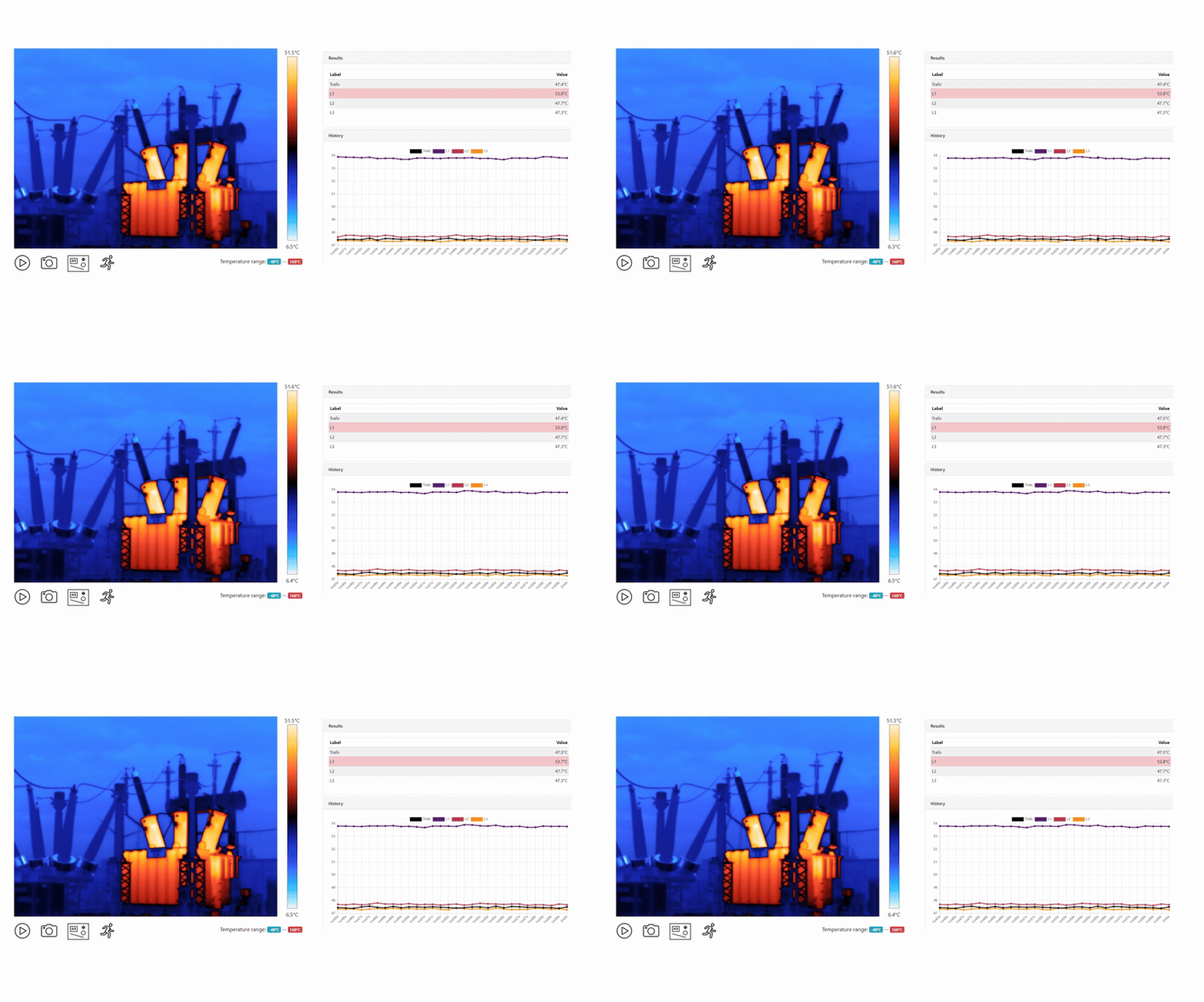
Optical systems, for example, convert geometric information via light projection and camera imaging into pixel coordinates. Thermal systems detect infrared radiation and derive temperature values from it.
The measurement chain includes the sensor, signal conditioning (amplification/filtering), digitization (ADC), evaluation, and, if necessary, compensation. Each element of the measurement chain contributes to measurement uncertainty.


Sie sehen gerade einen Platzhalterinhalt von Vimeo. Um auf den eigentlichen Inhalt zuzugreifen, klicken Sie auf die Schaltfläche unten. Bitte beachten Sie, dass dabei Daten an Drittanbieter weitergegeben werden.
Mehr Informationen