Get the most out of your production!

Automation Technology GmbH
Hermann-Bössow-Straße 6-8
23843 Bad Oldesloe
+1 (781) 435-4123
Home » Products » C7 CA Series

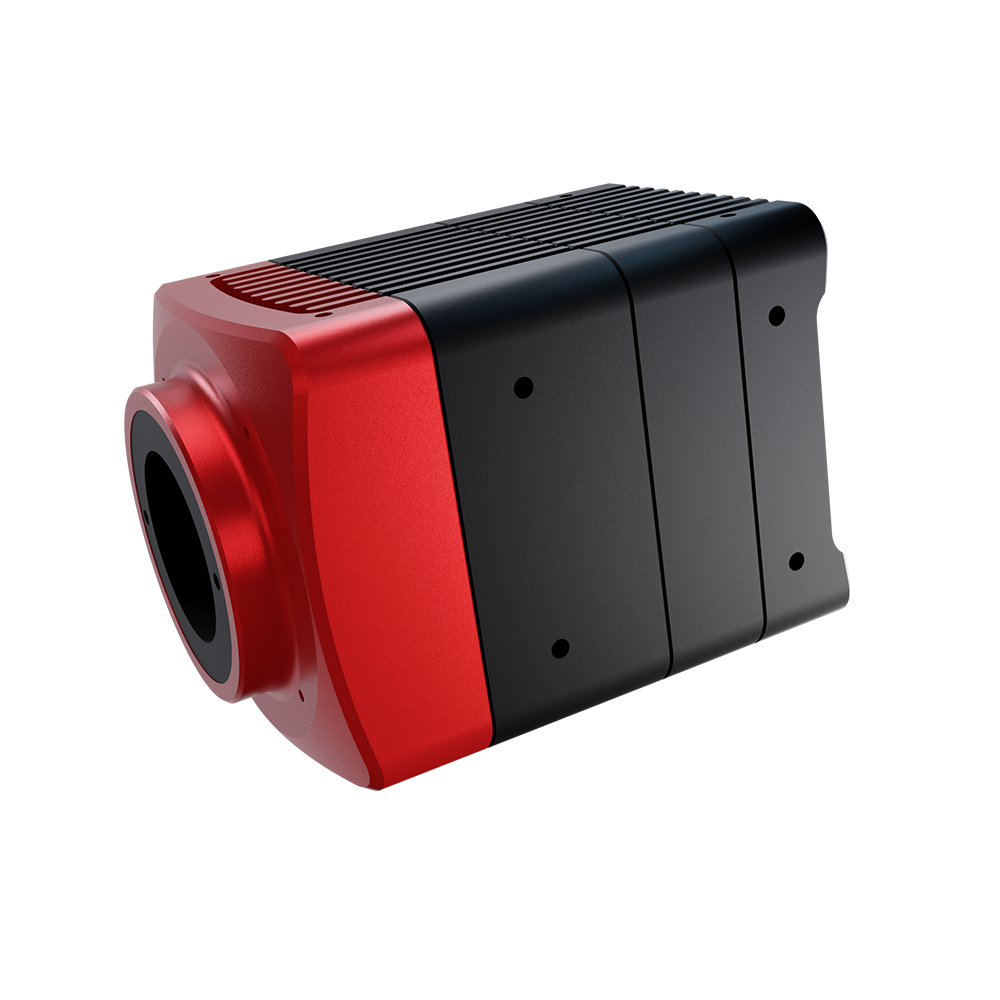
C7 CA Series High-Speed 3D Camera with 5 Gigabit Ethernet Data Transmission and Laser Link Connector

  • New integrated powerful processing unit
  • 5 times higher data throughput thanks to 5 Gigabit/s
  • Simultaneous output of multiple different features such as 3D profile data, reflectance (intensity data), and scatter signals, even in fast applications
  • Ultra-fast scanning of even the smallest components
  • New laser interface for connecting common laser line projectors
  • Significantly higher profile speed of up to 87 kHz in combination with WARP technology
  • Available with integrated Scheimpflug arrangement
  • New TFL mount available (optional C-mount)

Two models available
Compare both variants in the Technical Data section below.


High-Resolution 3D Camera for Flexible Industrial Applications

The C7 CA series stands out with maximum flexibility and powerful performance for a wide range of industrial image processing applications. With a resolution of 3072 pixels, it is ideally suited for a variety of demanding tasks. Integration into existing systems is exceptionally fast and convenient, thanks to the advanced 5G ethernet interface. The innovative LaserLink interface allows common lasers to be connected directly to the camera, further expanding the range of possible applications. Support for the GenICam standard, as well as various Scheimpflug configurations and model variants, make the C7 CA series the ideal choice for complex multi-sensor applications.

Application Recommendation

  • Advanced Packaging
  • Road Scanning
  • Railway Inspection

Detector/Performance Specifications

Detector CMOS | Global Shutter
Resolution 3072 × 1020 pixels
Physical Size 20.275 × 6.732 mm
Pixel Size 6.6 × 6.6 µm
Points per Profile 3072
Profile Speed at 200 Rows 4798.0 Hz 39968.0 Hz
Maximum Profile Speed 66489.0 Hz 87873.0 Hz

Interface Specifications

Ethernet 5GBase-T | up to 5000.0 Mbit/s
Encoder A, B, Z | RS-422 | HTL | TTL
Digital Inputs 2× isolated digital inputs | 5–24 V DC
Digital Outputs 2× isolated digital outputs | 5–24 V DC
Analog Output 1× analog output | 0–5 V DC

Electrical/Mechanical specifications

Power Supply 12 V – 24 V DC | 27 V DC Max.
Power Consumption Max. 15 W
Connectors Power & I/O: M12-Connector | 17-pin | A-coded
Ethernet: M12-Connector | 8-pin | X-coded
LaserLink: M8-Connector | 8-pin | A-coded
Housing Material Anodized aluminum
Dimensions (L × W × H) 79.8 mm × 55.0 mm × 55.0 mm
Weight 350.0 g

Environmental conditions

Temperatures Operating: 0 °C – +40 °C
Storage: –20 °C – +80 °C
Humidity 20 % – 80 % (non-condensing)
Vibration Resistance Sinusoidal: DIN EN 60068-2-6:2008-10: 2g | 10 Hz – 150 Hz
Random: DIN EN 60068-2-64:2009-04: 7g | 10 Hz – 500 Hz
Shock Resistance DIN EN 60068-2-27:2010-02: 15 g | 3 ms
Protection Class IP54 | According to IEC 60529

Software/Features

Supported Standards GenICam | GigEVision
Firmware Features RegionTracking | RegionSearch | MultiRegion | MultiPart | AutoStart |
HistoryBuffer | MultiSlope | MultiPeak
Software SolutionPackage | MetrologyPackage |
cxSDK with support for C, C++, C#, Python and Matlab/Octave
ThirdParty Support for Aurora, Cognex Vision Pro, CVB, Design Assistant, Halcon, EyeVision, Open eVision, MIL

Frequently Asked Questions about the C7 CA Series

How much does a 3D camera cost?

The triangulation cameras are ideal for applications with 3D profile sensors requiring maximum flexibility and the use of customer-specific lenses and line projectors. They start at a price of $7150.

Where can I find the data sheet for a product?

The data sheets for our products are linked via the item number in the tabular overview of our products in the product finder:

How much does an ECS 3D sensor cost?

The ECS series offers particularly good value for money, with sensors starting at a price of $6600.

Where can I find the latest firmware release for my 3d sensors?

You can find our AT SolutionPackage in the download area on our website:

What are the hardware requirements for operating the 3d sensors?

A network card that supports at least Gigabit Ethernet is required to operate the devices. A separate network port is recommended for each connected camera. The CPU and graphics card requirements depend on the application and are therefore specified by the image processing software used.

What do I need to bear in mind regarding the electrical installation for 3D sensors?

The electrical installation differs between cameras, compact sensors, and modular compact sensors. It is important to observe the specific information for the respective model to avoid damage to the device. We recommend using our IO panel.

What do I need to consider when using an encoder?

Profile recording can be synchronized by an external encoder signal. The encoder is specified for TTL levels and should not have signal levels above 5V DC, as higher voltages can damage the device.

The maximum number of lines is not enough to accommodate the entire object. What can I do to extend the frame?

Instead of extending the frame, you can split the recording into multiple frames without any loss of data. With the FrameBurstStart trigger, you can trigger multiple frames with a single start signal.

Can the 3D sensors communicate directly with a PLC?

The C6 series has two digital inputs and two digital outputs that can be connected to a PLC.

Are AT’s 3D sensors “smart 3D sensors”?

The term “smart sensor” generally refers to the evaluation of measurement data within the device itself. These sensors only transmit the results via their communication interfaces (e.g., Ethernet, Profinet, Modbus, or MQTT). AT’s 3D sensors, on the other hand, transmit the profile data to a PC via the GigE Vision interface. The data is then processed on the PC. AT 3D sensors are high-resolution, high-speed profile sensors. The amount of data generated by such sensors usually exceeds the performance capabilities of the CPUs built into cameras.

What is the warranty duration for the 3D sensors?

All CS, MCS and XCS series products are covered by a 2-year warranty, but the warranty for ECS products is only 1 year.

How do I know which 3D sensor is right for my application?

With our 25 years of expertise as component manufacturers in the field of 3D image processing, we have comprehensive knowledge in 3D laser triangulation sensor applications. Therefore, we can offer you optimal advice on which sensor is best for your application. Feel free to reach out to our sales team with confidence: [email protected].

How much does a MCS 3D sensor cost?

The costs naturally depend on the level of customization, but our sensors start at a price of $11220.

How much does a CS 3D sensor cost?

The CS series of 3D sensors offer a wide range of models for different applications and industries starting at a price of $11220.

How much does a XCS 3D sensor cost?

The 3D sensors of the XCS series are optimized for demanding high-precision and high-speed applications requiring better than average repeatability. Their price starts at $17050.

How much does a 3D camera cost?

The triangulation cameras are ideal for applications with 3D profile sensors requiring maximum flexibility and the use of customer-specific lenses and line projectors. They start at a price of $7150.

How do I configure my specific MCS?

Our sales team has a dedicated configurator for your specifications, allowing us to set it up together and generate the corresponding datasheet for you directly.

Do you have a quick start guide for your products?

You can find a summary of our quick start guides on our website.

Do AT devices support PoE?

No, our devices do not support PoE and may be damaged if connected to PoE.

Are you looking for more answers?
In our general FAQ, we have clearly compiled the most frequently asked questions about our sensors, cameras, interfaces, and applications.
Secret Link