
Get the most out of your production!

Automation Technology GmbH
Hermann-Bössow-Straße 6-8
23843 Bad Oldesloe
+1 (781) 435-4123
Home » Applications » Brick Inspection

Fully Automated Brick Inspection

120,000 Stones. 1% Rejection Rate

Around 120,000 concrete blocks run along the Kortmann Beton production line every day. This is a figure at which humans are not able to carry out 100% quality control. With just 1% rejects, automation is the most effective solution for production. Together with ibea, AT Sensors has developed an application that uses a 4090 camera to inspect the surface of the concrete blocks. This system has been firmly established in production since 2014 and sets new standards in terms of speed and reliability.
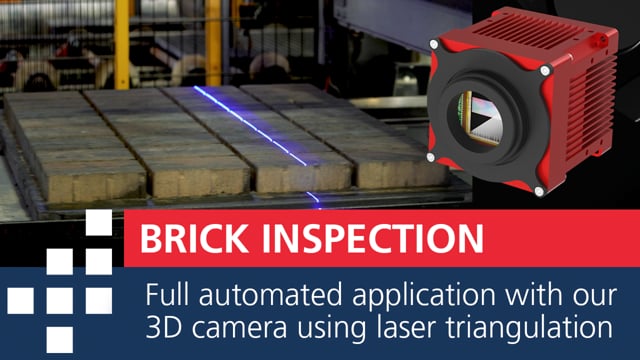
High-Precision Surface Inspection of Concrete Bricks

120,000 concrete blocks per day – that’s how many leave the Kortmann Beton GmbH & Co. KG factory in Schüttorf, Lower Saxony, every day. Each and every one of these blocks must meet certain geometric and optical quality criteria before it can enter the further production process. Given these dimensions, it is clear why manual quality control has its limits. Fatigue, subjective assessments, and the sheer workload make it impossible to ensure a consistently high inspection rate for a total of 4,000 transport boards, each carrying 30 blocks. At the same time, quality assurance is a crucial factor in concrete production. Even the smallest deviations, such as deformations of less than 0.5 mm, mini-cracks, or texture irregularities, can cause installation and laying errors, lead to complaints, and also result in high costs throughout the entire manufacturing process.
Defects from 0,5 mm
Highest Precision
30 Bricks at Once
Large FoV
Unmanned Operation
Automated Process

From Manual Inspection to Automated Quality Control

This was precisely the situation Kortmann found itself in, which quickly led to the desire to automate the quality control of the concrete blocks. The aim was to check both the geometric shape and the color of the products precisely and reliably. This was accompanied by the need to develop a system that would operate stably over the long term in the harsh production environment of a concrete plant without requiring operators to have in-depth technical knowledge.

Three partners worked closely together to implement this project. ibea from Hamburg, as the responsible OEM, developed the complete application, including software and system integration. AT Sensors from Bad Oldesloe contributed the 3D sensor technology, which was integrated into the solution as a core component. And Kortmann, as the end customer, not only provided the production environment, but also supported the development with practical requirements and feedback from ongoing operations.

Inspecting 120,000 Stones per Day at Full Production Speed

However, there were initially a number of challenges to overcome during the application development phase. With 4,000 boards to be inspected per day, each containing around 30 stones, the application had to be able to detect, analyze, and, if necessary, mark each product for rejection in a matter of seconds. In addition, a sensor was sought that would not only respond flexibly to the rough texture and varying grain of the stones, but also cover a large field of view while still delivering sub-millimeter resolution. AT Sensors therefore proposed the use of a 3D triangulation camera with a resolution of 4,096 pixels and a speed of up to 24 kHz.

Sub-Millimeter Precision on Rough, Irregular Surfaces

The precise triangulation camera projects a laser line across the stone, captures the height profile, and detects even the smallest geometric deviations—from dimensions, shapes, and angles to hairline cracks. “The application required a customized sensor solution that could be integrated precisely into the system designed by ibea. And this is precisely where AT Sensors has a decisive advantage over the competition: our solutions are tailored to customer requirements, eliminating unnecessary complications and saving costs and effort in integration and maintenance,” explains Dr. Athinodoros Klipfel, Sales Manager at AT Sensors.

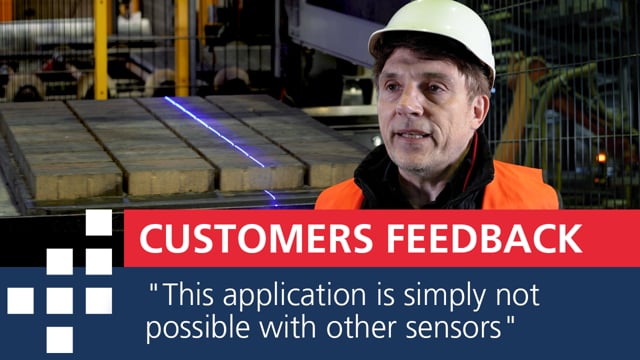
Michael Newger, Head of Development at ibea, adds: “The decision to use AT sensors was not a random one for us. We first opted for this technology back in 2014 because the resolution and functionality it offered was unrivalled on the market, and in our opinion still is.” He continues: “What’s more, the cameras are optimally designed for complex multi-sensor applications, such as those required in concrete plants. The availability of various Scheimpflug configurations also allows flexible adaptation to different inspection geometries and working distances.

Real-Time Defect Detection and Automatic Rejection Without Cycle Time Loss

Ibea developed software for this application that enables both pixel-precise analysis and intuitive operation. Detected defects are transferred to the inspection software in real time, where they are automatically classified and marked. A downstream robot precisely removes the defective bricks from the running production line without affecting the cycle time through inspection and sorting.

The development phase from initial concept to series production took around six months. During this time, a prototype was created and extensively tested during ongoing operation. The focus was on optimizing the evaluation algorithms, adapting the robot control system, and precisely calibrating the sensor parameters until the system achieved the required process reliability.

Less Scrap, No Downtime, Full Documentation

For Kortmann, the application offers several key advantages. The system enables fully automatic inline quality control that operates around the clock without personnel and sorts out defective bricks in real time. This has reduced the reject rate to around one percent. At the same time, production interruptions, rework, and returns have been significantly reduced, which saves costs and increases process reliability. The staff also benefits, as monotonous control tasks are no longer necessary. In addition, product quality can be seamlessly documented and marketed in a targeted manner—a clear added value in sales.

The system is modularly expandable and is being continuously developed at Kortmann. It was successfully established in close cooperation between Kortmann and ibea, while AT Sensors provided the basis for it with the appropriate sensor technology. This project is now also considered a reference for similar applications, such as in brick production.

A Blueprint for Automated Quality Assurance in Concrete Production

The application illustrates how powerful 3D sensor technology from AT Sensors, combined with specialized software and system development by ibea, enables a testing procedure that would not be possible manually. With sub-millimeter accuracy, automatic sorting without loss of cycle time, and a significant reduction in scrap, the solution combines precision, efficiency, and sustainability. This makes the application for testing concrete blocks a pioneering example of industrial innovation—both for today and tomorrow.


“The decision to use AT sensors was not a random one for us. We first opted for this technology back in 2014 because the resolution and functionality it offered was unrivalled on the market, and in our opinion still is.”
Michael Newger
IBEA, Chief Technical Officer (CTO)

Your Benefits

High-Speed
The high speed of the sensor enables a fast and efficient inspection of the brick surface.
Field of View
The 3D camera enables a variety of different configurations and fields of view, making it flexible for use in various applications.
Precision
High accuracy thanks to the 4K sensor (4096 pixels) ensures precise detection of surface irregularities and defects.
Get the most out of your production!
🇺🇸 North America
🇩🇪 Worldwide
Secret Link