Get the most out of your production!

Automation Technology GmbH
Hermann-Bössow-Straße 6-8
23843 Bad Oldesloe
+1 (781) 435-4123
Home » Applications » BGA Inspection

Inline BGA Inspection for AI Power Modules

Precise Coplanarity Measurement at 12.5 kHz

The global AI boom is giving rise to ever larger and heavier electronic components, causing many inspection systems to quickly reach their limits. Together with AT Sensors, ASMPT has developed a custom 3D laser profile sensor that reliably inspects even the next generation of AI power modules inline. A look behind the scenes of a collaboration that demonstrates what high-tech 3D measurement technology must achieve today.
Why Next-Generation BGA Components Demand a New Approach to Inspection

A profile rate of 98,000 profiles per second, a measurement field of 180 × 180 millimeters, and an optical design that reliably captures even reflective solder ball surfaces: These performance figures set a new standard in inline-capable BGA inspection. The catalyst for this is not a new technology hype or a trend, but a very concrete market reality: AI accelerators and high-performance processors are growing rapidly in size and weight, at a rate that conventional inspection systems can no longer keep up with. Currently, the modules already weigh around 500 grams; in the future, individual components could even reach up to 2.5 kilograms.

Ball Grid Arrays, or BGAs for short, are the heart of modern electronics, which is why quality control plays a crucial role here. The tiny solder balls on which each component sits perform two critical and highly sensitive tasks: they ensure the electrical connection and keep the component mechanically stable on the printed circuit board. Even the slightest deviations in the height or flatness of individual solder balls can therefore have massive consequences. Invisible contact defects, thermal issues, or even electrical stress are just a few negative examples that often only lead to failure once the device is in operation. This is precisely why reliable inline inspection is an absolute prerequisite for any scalable and stable AI hardware manufacturing. And this is exactly where ASMPT and AT Sensors combine their expertise.

Full Coverage for Oversized AI Modules
180 × 180 mm Measurement Field
Complete 3D Capture at Full Production Speed
12.5 kHz Profile Rate
Reproducible Results on Solder Balls
Reflective Surface Mastery

The Development of the BGA Inspection Solution

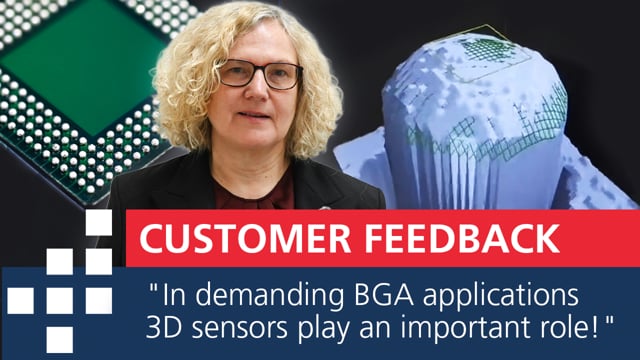
ASMPT, a global technology and market leader in hardware and software solutions for smart electronics manufacturing, saw the AI boom as a clear strategic opportunity to consistently further develop its solutions. The existing sensor solution for BGA inspection was simply no longer designed for the new generation of components. “Our customers demand increasingly comprehensive quality monitoring, particularly for BGAs and complex connectors. At the same time, the systems must continue to operate at high cycle rates. This places high demands on the measurement technology used,” explains Petra Klein-Gunnewigk, Senior Product Manager Placement Solutions at ASMPT SMT Solutions.

Therefore, the search was not for a completely new system, but rather for a customized 3D laser profile sensor with significantly increased measurement performance that could be integrated as a direct replacement into the existing ASMPT machine platform. ASMPT found the solution through a collaboration with AT Sensors, a world-leading manufacturer of high-precision 3D laser profile sensors based near Hamburg.

The Key Challenge: Measurement Field, Resolution, and Reflectivity

The requirements for the new laser profiler were demanding: a larger measurement field, greater precision, and higher speed. In practice, this is precisely the ultimate challenge in 3D sensor technology, as these three requirements typically conflict with one another. A larger measurement field comes at the expense of detail sharpness. Greater precision requires more complex optics. Higher speed drives up the demands on data processing. Anyone who needs all three at the same time must think beyond standard solutions.

Added to this was a material-specific challenge: solder balls reflect incident light. Sensor systems that perform excellently on diffusely scattering surfaces often deliver unstable or non-reproducible measurement results on reflective metal surfaces. Two factors were therefore decisive for the collaboration with AT Sensors: the proven image quality on highly reflective surfaces and the high measurement speeds already offered by AT’s existing sensor portfolio. Added to this was a strategic advantage: AT Sensors offers a modular sensor concept that enables customer-specific solutions without long lead times, extra costs for customization, or minimum order quantities.

High-Precision Coplan Laser Profiler from AT Sensors

The joint development ultimately took around two years. During this time, the optics, electronics, and geometry of the 3D laser profile sensor were precisely tailored to the requirements of ASMPT’s SIPLACE placement machines until a custom 3D laser triangulation sensor was created, known internally at ASMPT as the “3D Coplan Module”: the C6-3070CS. “The combination of precise coplanarity measurement and intelligent data analysis forms the basis for stable placement processes. That is why we are pleased to use components from AT Sensors, a reliable and high-quality supplier,” comments Petra Klein-Gunnewigk on the deliberate choice of AT Sensors.

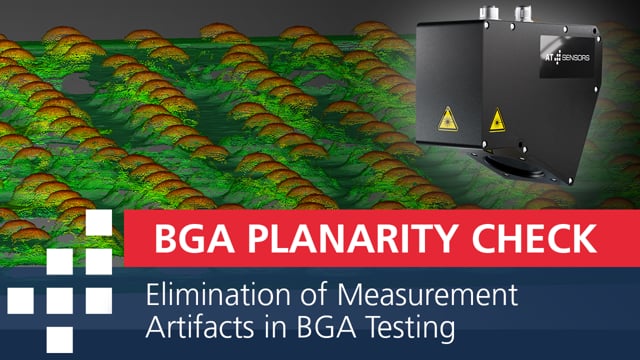
What distinguishes the AT Laser Profiler from standard solutions is its specific design tailored to the requirements of BGA inspection. With 3,072 measurement points per profile, it delivers exceptionally fine resolution across the entire measurement field. The profile rate is 12.5 kHz, enabling complete 3D capture of the BGA surface even at the high transport speeds required by inline operation on the production line.

Furthermore, the C6-3070CS is designed to deliver stable and reproducible measurement data even with reflective solder balls, which is another key difference from standard sensors that often struggle with saturation effects or measurement artifacts when dealing with these surface properties.

The sensor’s measurement field also fully covers modules up to 180 × 180 millimeters. For particularly large-format components whose dimensions exceed the field of view of individual sensor scans, a stitching process is used: multiple profile scans are combined into a coherent 3D dataset that represents the entire BGA surface. “Developing customized solutions for our customers is not just one of our guiding principles. Because we were once integrators ourselves and have more than 25 years of application experience, we can also understand our customers’ requirements very well and translate them into optimal technical solutions,” explains Dr.-Ing. André Kasper, CTO of AT Sensors.

How Inline BGA Inspection Works in Practice

For the machine operator on the production line, the inspection process remains incredibly simple: The AI Power Modules pass through the ASMPT SIPLACE placement machine at the normal production cycle. While the modules are in transit, the Coplan sensor continuously captures high-resolution 3D profiles of the BGA underside.

The integrated evaluation software analyzes the acquired 3D data in real time and calculates the relevant quality parameters for each individual solder ball: ball height, diameter, geometry, and coplanarity—that is, the uniformity of height distribution across the entire contact surface, which is considered a key quality characteristic in this BGA inspection. Deviations from the defined tolerance range are immediately detected, and the affected components are automatically rejected before they can cause costly subsequent problems.

At the same time, the system provides valuable process data. The recorded measurement values form a reliable basis for statistical analysis, enable the identification of trends, and lay the groundwork for data-driven optimization of the entire manufacturing process. “Reliable quality control is the crucial foundation for modern AI hardware in electronics manufacturing, ensuring that this hardware can be produced in the required quality and quantity,” says AT CTO André Kasper.

Conclusion

The collaboration between ASMPT and AT Sensors impressively demonstrates how closely modern electronics manufacturing and precision measurement technology must work together. The custom Coplan sensor C6-3070CS delivers exactly what today’s applications require: a large measurement field for modules up to 180 × 180 millimeters, high resolution for precise coplanarity measurements, profiling rates in the kilohertz range for inline operation, and an optical design that reliably handles even highly reflective solder ball surfaces.

At the same time, this BGA application solution looks beyond today’s production needs: The Coplan laser profiler is already designed for component generations currently still in development and integrates seamlessly into existing systems as a direct replacement without requiring costly modifications. What remains is the familiar infrastructure. What is added is an inspection solution that not only meets today’s requirements but also those of the future. In a market that moves as fast as that of AI hardware, this is perhaps the most decisive advantage of all: those who invest today won’t have to start over tomorrow.


“The combination of precise coplanarity measurement and intelligent data analysis forms the foundation for stable assembly processes. That is why we are pleased to use components from AT Sensors, a reliable and high-quality supplier.”
Petra Klein-Gunnewigk
ASMPT SMT Solutions, Senior Product Manager

Related Applications

Your Benefits

High-Precision
Stable, reproducible measurement data even on highly reflective solder balls – where standard sensors fail.
High-Speed
Captures complete 3D profiles of every BGA surface at full inline production speed – without slowing down the cycle.
Field of View
Fully covers even the largest AI power modules – including oversized components via integrated stitching process.
Get the most out of your production!
Secret Link