

Automation of Laser-Based Food Branding
Labeling of Fruits and Vegetables Using 3D Laser Profilers
You are currently viewing a placeholder content from Vimeo. To access the actual content, click the button below. Please note that doing so will share data with third-party providers.
More Information


Labeling Food Directly on the Skin
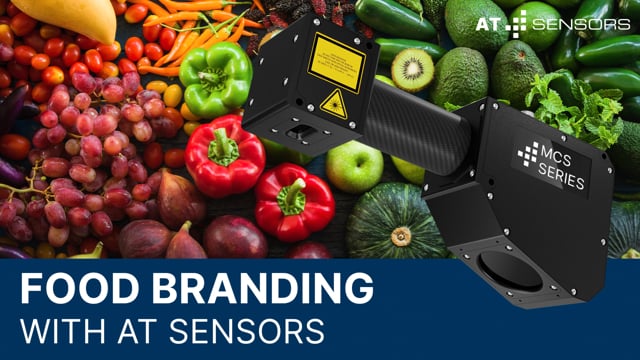
AT Sensors has collaborated with system manufacturer EcoMark to develop an application that enables food products to be marked directly on the packaging using laser marking. AT’s compact CS2040 3D laser profile sensor determines the position of the fruit or vegetable on the conveyor belt and then transmits this signal to the marking laser.
You are currently viewing a placeholder content from Vimeo. To access the actual content, click the button below. Please note that doing so will share data with third-party providers.
More Information

Natural Branding as a Response to Plastic Packaging
Plastic-free food marking: What sounded like a niche idea just a few years ago is now becoming one of the most relevant trends in the food industry. Instead of labels and plastic packaging, fruits and vegetables are marked directly on the skin using a laser: with origin information, barcodes, or logos permanently, residue-free, and fully biodegradable.
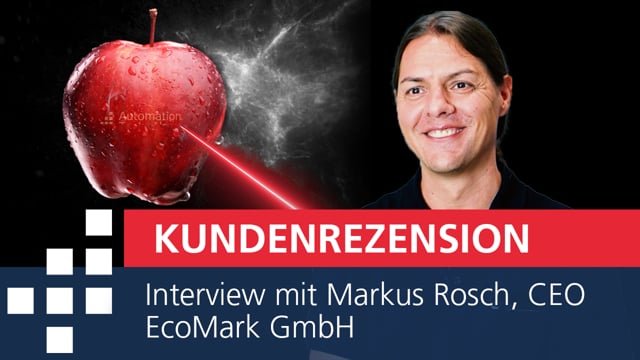
EcoMark GmbH specializes in precisely this technology and is now one of the largest international providers of food and natural branding. The idea originated in 2018, building on years of expertise in the field of laser marking. Since then, EcoMark has developed a machine that marks up to 100,000 fruit products per hour while responding fully automatically to any product geometry.
For the precise positioning of the marking laser, EcoMark has relied on 3D sensor technology from AT Sensors from the very beginning.
The Challenge: Precise Laser Positioning Despite Varying Product Geometries
The central challenge in food branding is that no two products are alike. Kiwis, cucumbers, avocados, tomatoes: Each variety has a different size, a different surface texture, and a different position on the conveyor belt. To align the marking laser individually and with millimeter precision for each product, the system requires precise 3D data in real time at full production speed.
The Solution: Zero Packaging Costs Thanks to 3D Sensor Technology
With the CS2040 compact 3D sensor, AT Sensors offers the ideal product for this specific application. It scans every product on the conveyor belt and generates a complete 3D point cloud within milliseconds, which in turn serves as the basis for precise laser control. With a resolution of 2,048 measurement points per profile and a measurement width of up to one meter, the sensor responds flexibly to changing product positions and sizes without the need for manual readjustments.
“EcoMark is a perfect example of the unique diversity of AT’s more than 300 sensor variants. Based on the customer’s technical specifications, we were able to deliver the right 3D laser profile sensor that precisely meets their requirements. We always strive to offer the best possible product for each of our customers to significantly enhance their processes and increase their effectiveness,” explains Daniel Seiler, CEO of AT Sensors.
Another key advantage: The 3D laser profile sensors in the CS2040 family are factory-calibrated and feature a standardized GigEVision interface. This enables to provide straightforward plug-and-play integration into any existing marking system without additional installation effort and without requiring specific image processing expertise on the customer’s part.
Why Food Branding Is the Cost-Effective Alternative
In addition to its technical capabilities, natural branding is particularly compelling due to its cost-effectiveness. The investment is limited to the one-time purchase of the marking system, while ongoing packaging costs are completely eliminated. Compared to traditional plastic solutions, this results in a significant cost advantage that becomes apparent shortly after commissioning. “We are very optimistic that the trend toward food labeling directly on the container will gain traction in the future. Ultimately, this method is significantly more cost-effective than previous plastic solutions. We only incurred costs at the start of production through the purchase of the labeling system; further follow-up costs are very low,” says Markus Rosch, CTO of EcoMark.
In addition, natural branding opens up new possibilities in the area of food tracking: Each product can be assigned a unique code, enabling seamless tracking from the producer to the supermarket shelf.
From Kiwis to Cucumbers: Flexible 3D Inspection for Every Type of Fruit and Vegetable
For the 2040CS 3D laser profile sensor, it doesn’t matter which product is on the conveyor belt. The system detects the shape, position, and surface texture of every single piece of fruit or vegetable in real time and controls the marking laser accordingly. Even at high throughput speeds, the accuracy remains consistently high.
This flexibility is crucial, as an incorrectly calibrated laser would damage the skin and render the product unsellable. The combination of 3D point cloud data and precise laser control ensures that the marking is always perfectly positioned: deep enough for good visibility, yet gentle enough to preserve the product’s shelf life.
The Conclusion: Sustainable, Cost-effective, and Scalable
The food branding application from EcoMark and AT Sensors demonstrates how modern 3D sensor technology is fundamentally transforming a traditional industrial process. What used to be done manually or with complex packaging logistics is now fully automated, more precise, more cost-effective, and more sustainable.
The 2040CS laser profile sensor from AT Sensors provides the technological foundation: With its high resolution, flexible measurement width, and simple plug-and-play integration, it is precisely tailored to the requirements of food branding. And with a marking capacity of up to 100,000 products per hour, the application sets new standards in terms of speed and reliability, all with minimal maintenance requirements.
You are currently viewing a placeholder content from Vimeo. To access the actual content, click the button below. Please note that doing so will share data with third-party providers.
More Information


Sustainable Labeling

Flexible Branding Options
