

Can Check
Testing 2,400 Cans per Minute
You are currently viewing a placeholder content from Vimeo. To access the actual content, click the button below. Please note that doing so will share data with third-party providers.
More Information


The Challenge
However, in order to develop this application in the first place, a number of challenges had to be overcome. EVT and AT Sensors had to come up with a solution for checking 40 cans per second at maximum speed on a conveyor belt just two meters long using innovative image processing. And it wasn’t just a matter of evaluating the can, but also of ejecting the beverage container if it did not meet the specified standards in terms of filling pressure and fill quantity. “The can inspection system is characterized above all by its enormous speed and very high precision. During development, we had to ensure above all that the data was accurate and that the correct cans were ejected. After all, the machine runs 24/7 in continuous operation, so reliability played a decisive role,” explains Michael Beising, Managing Director of EVT. In this context, EVT and FILTEC then suggested AT Sensors as the sensor supplier. “We have known AT since its founding, and even back then, AT was one of the companies that developed the most impressive 3D sensors globally. Therefore, we quickly realized that this was exactly the right solution for can inspection,” Beising continues.
The Sensor Decision
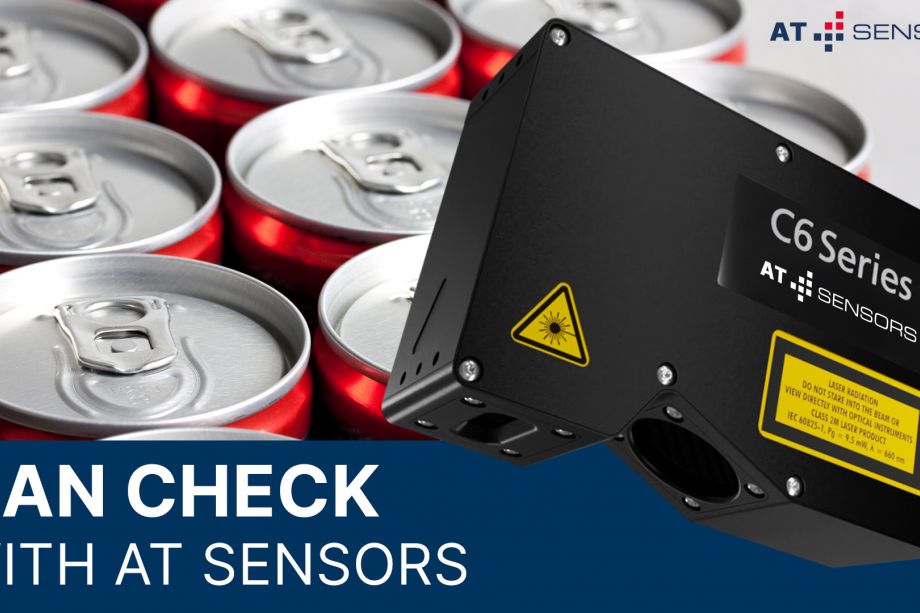
AT opted to use C6-2040CS-23-100 compact 3D sensors for this application. With a resolution of 2,048 points per profile, these sensors are not only highly accurate, they also impress with an enormous speed of 25,000 profiles per second. The wide viewing range of 100 millimeters of this model is also worth mentioning. This allows the sensor to react flexibly to the position of the can on the conveyor belt. “In addition to using only high-quality technology, the customer benefit is always a priority for us, as we always focus on long-term cooperation in our customer relationships. The 2040 compact sensor is equipped with standard interfaces such as GigE Vision and GenICam 3D. This means that the application can be easily and simply implemented in any new filling machine at any time using the plug & play principle,” says Dr. Athinodoros Klipfel, Sales Manager at AT. EVT CEO Michael Beising adds: “AT worked as an integrator for many years before becoming a sensor manufacturer. As a result, the colleagues at AT have a wealth of expertise and knew even then exactly which 3D sensors would be best suited for this application. This meant that all the prerequisites were in place for the reliable output of precise point clouds, which always form the basis for good image processing.”
Incidentally, poor quality management was the decisive factor in the development of can pressure control in 2013. The beverage manufacturer was repeatedly faced with the problem of downtimes during the filling process due to, for example, faulty bulges on the can surface. In order to eliminate these downtimes once and for all, optimize the inspection process, and significantly increase can production, the beverage manufacturer hoped to achieve profitable success by developing a system for inspecting can printing. Before delivery to the end customer, FILTEC tested the AT sensors for three months in 24/7 operation to ensure that the technology met all the required specifications.
The Software Solution
EVT then developed the software for the application, which enabled pixel-precise analysis. It was important to the Karlsruhe-based company that the customer did not need any image processing knowledge to be able to use it. On the contrary: the goal was to simply start a program, select a few tools, and the machine could start right away. “We typically have to continuously develop our software in order to keep up with ever faster processors and production processes. With the can inspection application, however, it’s exactly the opposite. The 3D sensors have been running flawlessly in conjunction with the software for years, so we don’t want to change anything about the application, as the entire system would possibly have to be re-qualified,” says Michael Beising.
The Benefits
In fact, the application works so well that, in normal operation, at most one can per day has to be rejected due to a pressure issue. [does this mean a false reject or only one can a day has a pressure issue?. The conveyor belt has been specially equipped with a tracker for pressure control, which in turn is connected to the 3D sensor. If this transmits a 3D point cloud that deviates from the norm, the can disappears from the conveyor belt within milliseconds via compressed air.
The Conclusion
The can inspection system for FILTEC demonstrates how modern image processing takes quality assurance to a new level in 24/7 continuous operation. The application combines maximum speed, absolute reliability, and seamless plug-and-play integration. This not only ensures consistent product quality and minimizes downtime, but also creates a scalable, globally applicable solution for the beverage industry. The renewed large orders from FILTEC underscore that sustainable, stable partnership-based cooperation pays off, with many other beverage manufacturers now also benefiting from this efficient application.



Flawless Functionality

Inspection at Maximum Speed