Get the most out of your production!

Automation Technology GmbH
Hermann-Bössow-Straße 6-8
23843 Bad Oldesloe
+49 (0)4531 / 88011-0
Home » Applications » Steel Edge Inspection

Real-Time 3D Laser Inspection of Steel Edges

Inspection at Speeds of 350 Meters / Minute

When steel strips run at 350 m/min, every micrometer matters. Powered by the AT Sensors CS 1280 3D laser profiler, ArcelorMittal Bremen and Selmatec have implemented a smart inline inspection solution that detects edge defects in real time, improves product quality and helps reduce scrap before it occurs.
Micrometer Precision for Perfect Steel Edges

In steel processing, micrometers determine whether a product is scrap or of high quality. Minor edge damage to steel strips can lead to forming cracks, production interruptions, and increased scrap rates. Together with system integrator Selmatec and AT Sensors, ArcelorMittal Bremen has developed an inline inspection solution that automatically and precisely scans sheet edges during ongoing production at speeds of up to 350 meters per minute. 

A blade that loses its sharpness, a steel strip running at 350 meters per minute through a trimming line, and a sheet edge whose quality determines whether there will be dimensional deviations, production interruptions, or scrap: These requirements define the framework for an application currently being developed at ArcelorMittal Bremen’s cold rolling mill. The focus is on the automated quality monitoring of steel edges during the production process.

And this is precisely where ArcelorMittal Bremen, Selmatec Systems, and AT Sensors are pooling their expertise. Their shared goal: a robust inline solution that reliably detects edge defects even at high production speeds and reports them in real time to higher-level systems, thereby significantly improving the quality of the so-called trim edges—that is, the edges created during the slitting of coils.

Detection of edge defects in real time
Reduced Production Waste
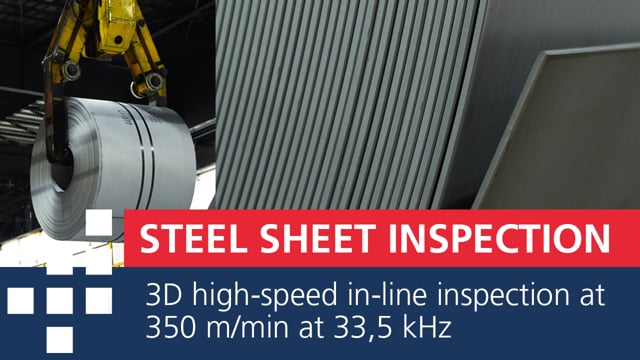
Reliable 3D inspection at speeds up to 350 m/min
More Process Stability
Maximize blade utilization
Optimized Tool Lifetime

Challenge: Speed, Robustness, Precision

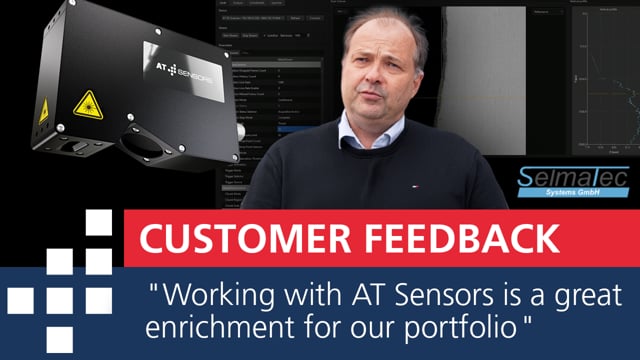
However, the challenge did not lie solely in defect detection itself. Production speeds of up to 350 meters per minute place high demands on sensor technology, data acquisition, and data processing. At the same time, the measurement data must be reliable and reproducible, regardless of material properties or environmental conditions. Conventional camera-based approaches, in particular, often reach their limits here, as they are highly dependent on lighting conditions. The decision was therefore made to use a 3D laser triangulation solution from AT Sensors. “We have been working with AT Sensors for several years now. And for us, it is a major benefit that we share a very similar way of thinking and working in engineering, so that as a system integrator, we can serve as an optimal bridge between AT’s 3D laser profile sensors and ArcelorMittal as the end customer. In plain language, this means we can optimally translate the requirements and the steel manufacturer’s needs. As is the case here with sheet edge inspection,” explains Michael Selent, CEO of SELMATEC.


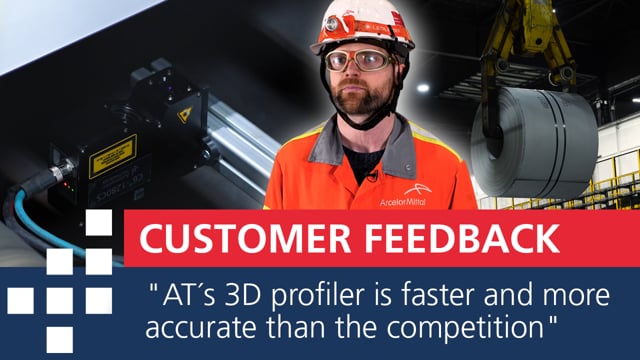
And Gerrit Schröder, application engineer at ArcelorMittal Bremen, adds: “Given the high cycle rates of the steel strips, traditional 2D camera systems are of limited use: changes in lighting due to vibration, reflections from metallic surfaces, and varying material properties lead to unstable measurement results. What really matters for quality control at is the three-dimensional geometry of the edge—that is, the profile, burr formation, notch depth, and edge uniformity. These parameters can only be reliably captured through true 3D measurement.”

The requirements for the sensor were correspondingly demanding: a high profile rate for seamless detection at maximum speed, sufficient lateral resolution for detecting relevant edge defects, and stable measurement data delivery across a wide range of surface properties—from bright-rolled to oxidized steel. Added to this is the harsh industrial environment: vibrations, dust, scale, and fluctuating temperatures are not exceptions in the cold rolling mill, but the norm.

The AT Sensor: C6-1280CS23 for High-Speed Scanning

Based on these requirements, AT Sensors Selmatec proposed the use of the C6-1280CS23-29 GigE 3D laser profile sensor of laser class 3R with a laser wavelength of 405 nanometers for this application. The blue laser technology used enables particularly precise detection of fine edge structures and delivers stable measurement results even on highly reflective metal surfaces.

The sensor operates on the principle of laser triangulation: A projected laser line is captured by a CMOS sensor from a defined viewing angle and converted into a high-resolution 3D profile of the strip edge. With 1,280 measurement points per profile, an X-resolution of 21.9 µm and a Z-resolution of 0.7 µm, as well as a profile rate of up to 174 kHz and a field of view of 28 mm, even the smallest geometric deviations, burrs, or tears can be reliably detected.

In addition to the high measurement rate, the solution offers another decisive advantage: thanks to AT Sensors’ modular sensor portfolio, the field of view can be precisely adapted to the specific application. Furthermore, intelligent evaluation functions ensure stable and reproducible measurement data even under demanding production conditions.

“The steel industry is facing ever-increasing quality requirements: tighter tolerance specifications, rising demands on surface quality and profile accuracy, as well as growing pressure for zero-defect production. Seamless, inline-capable quality control is therefore indispensable, and this is exactly where AT Sensors comes in,” explains Dr.-Ing. Athinodoros Klipfel, Sales Manager at AT Sensors. “The steel industry is one of our most important focus markets. That is why we are specifically developing our sensor technology to meet its requirements, with the ability to precisely adapt our sensors to the respective application without compromising on delivery time or cost-effectiveness.”

An additional benefit arises in tool monitoring: If the blade used to cut the coils loses its sharpness, the quality of the edges deteriorates progressively. Continuous monitoring makes it possible for the first time to precisely determine the optimal time for a blade change, thereby avoiding unnecessary maintenance measures as well as quality losses. For ArcelorMittal Bremen, this means greater process stability, less scrap, and consistently high quality of the end product.

“The innovation behind this is to meaningfully evaluate the robust, precise, and fast 3D laser triangulation measurement in real time and to transmit signals for defect marking to higher-level control systems via standard interfaces such as OPC-UA, ProfiNet, or Modbus,” says SELMATEC Managing Director Michael Selent, describing the core task of the project. This direct integration into the production control system is crucial for ensuring that operational actions can be taken based on measurement data, such as a timely blade change before the edge quality falls below the tolerance range.

How the Inline Edge Inspection System Works

The edge inspection system is integrated into a section of the cold rolling mill at ArcelorMittal Bremen. As the steel strip continuously passes through the cutting line, the laser profile sensor continuously captures high-resolution 3D profiles of the strip edge. The software developed by SELMATEC immediately analyzes the geometric data and detects irregularities or defects in real time.

The results are transmitted to higher-level control systems via standard interfaces such as OPC-UA, Profinet, or Modbus, where they can be processed immediately. Defect locations can be automatically marked, or process parameters can be specifically adjusted. This results not only in pure quality control but also in active process monitoring.

In addition, the comprehensive documentation of all measurement data opens up possibilities for process analysis: How does the edge profile change over the service life of a blade? Under which process parameters do certain defect patterns occur more frequently? Such data forms the basis for data-driven optimization of the entire trimming process.

Conclusion

The development of automated steel edge inspection for ArcelorMittal Bremen illustrates the contribution that modern 3D measurement technology can make today to process and quality assurance in the steel industry. The C6-1280CS23-29 GigE 3D laser profile sensor from AT Sensors forms the basis for robust inline inspection at strip speeds of up to 350 m/min. SELMATEC complements the solution with system integration, real-time evaluation, and connectivity to industrial control interfaces.

At the same time, the project underscores that high-precision 3D laser profile measurement technology is no longer used exclusively in the electronics or automotive industries. Especially in heavy industry, real-time capability, reproducible measurement data, and seamless process monitoring are becoming increasingly important.

Companies that can reliably monitor the quality of their strip edges during production reduce scrap, optimize tool usage, and lay the groundwork for comprehensive quality documentation. This is precisely where the true value of this technology lies: greater process control, more stable production processes, and consistently high-quality end products.


“The advantage of the AT sensor is that its high sampling rate enables comprehensive steel edge detection. I honestly hadn’t realized that the resolution would be as high as it is, which means we can now detect even the tiniest burrs that are invisible to the naked eye.”
Gerrit Schröder
ArcelorMittal, Automation Engineer

Your Benefits

High-Speed
The CS 1280 achieves the world’s fastest profile speed of up to 200 kHz, greatly boosting productivity in your manufacturing line
Precision
By utilizing features like MultiSlope, MultiPart, and MultiPeak, the CS 1280 delivers extremely accurate results, ensuring high product quality.
Integration
Thanks to compatibility with GigE-Vision / GenICam 3D, the sensor seamlessly integrates into your existing image processing software.
Get the Most Out of Your Production!
Secret Link