
Get the most out of your production!

Automation Technology GmbH
Hermann-Bössow-Straße 6-8
23843 Bad Oldesloe
+1 (781) 435-4123
Home » Applications » Tire Inspection

Automated Tire Inspection and Classification

Full 3D Analysis in 10 Seconds per Tire

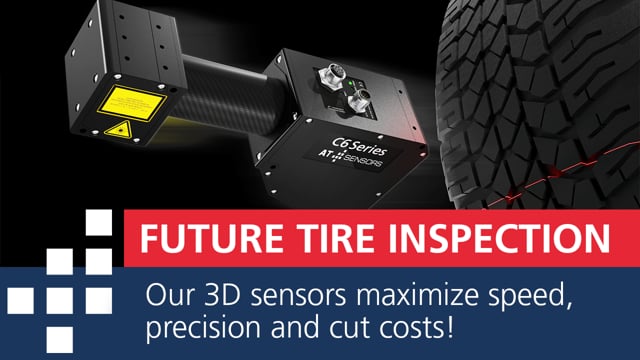
TireTech, AT Sensors, and aku.automation have jointly developed a fully automated tire inspection system that classifies used tires in just ten seconds. Three modular C6 2040 compact sensors from AT Sensors capture a complete 3D point cloud of each tire via laser triangulation – the basis for the AI-powered decision on whether a tire is retreaded, recycled, or processed into granulate.
Why Next-Generation Tire Sorting Demands a New Approach

Around 3.4 million tonnes of used tires accumulate across Europe every year – in Germany alone, that figure stands at approximately 600,000 tonnes. Not every tire needs to be disposed of immediately: many can be retreaded and returned to the road, while others are best processed into granulate for new tire production. The problem is that determining which tire qualifies for which purpose has traditionally been a slow, manual, and error-prone process, taking an average of two minutes per tire.

It was precisely this inefficiency that inspired Bernhard Brain, founder and CEO of TireTech GmbH, to rethink the process entirely. Watching tires being disposed of at a petrol station in 2019, Brain – a mechanical engineer by training – began developing a vision for a fully automated tire inspection system together with his business partner and co-founder Karl Staudinger. What started as an idea quickly grew into a serious development project, with a ten-person team now working to bring the solution to market.
Complete 3D classification of every tire
10-Second Full Analysis
No NRE costs, no minimum order quantities
Modular Sensor Design
Deep learning algorithms for automated sorting
AI-Powered Classification

How It Works: Full 3D Classification in 10 Seconds

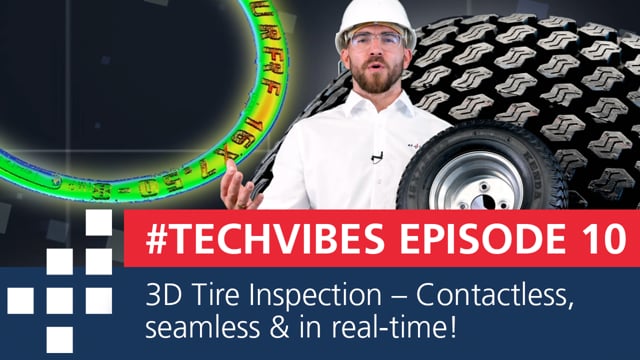
The TireTech inspection system guides each tire via conveyor belt into the center of the machine, where it is positioned horizontally for scanning. Three modular C6 2040 compact laser profilers from AT Sensors then scan the rotating tire using laser triangulation, capturing a complete 3D point cloud within just ten seconds.

This point cloud delivers precise data on all relevant tire characteristics: profile depth, contour, height, shape, and volume. Based on this data, the system classifies each tire by manufacturer, size (width, aspect ratio, diameter), season (summer or winter), DOT number, special markings such as ContiSeal and ContiSilent, and original equipment identifiers including AO, MO, TO, NO, AR, and MOE. The result is a fully automated sorting decision – retreading, recycling, or granulate processing. Without any manual intervention.

Why AT Sensors: Modular Design Meets Application Precision

The choice of AT Sensors for this application was not coincidental. TireTech’s developer and Sales Manager Marcel Staudinger explains the decision: “We were recommended AT’s sensors and were immediately impressed by the modular principle of the product range. We were able to configure the sensors exactly to our requirements – like a modular system – choosing both the triangulation angle and the required laser power ourselves. The large field of view and accuracy of the 2040 3D laser profile sensors were also convincing.”

This modularity is a key differentiator. As AT’s Senior Sales Manager Armin Jehle points out: “With the modular 3D compact sensors, AT overcomes for the first time the problem that triangulation sensors have always been associated with high NRE costs and long development times due to resolution, speed, and flexibility requirements. Based on the MCS concept, AT can deliver the optimally tailored sensor for every application as an individual solution with the reliability of a series product – without additional costs for customer-specific developments, without minimum order quantities, and without long delivery times.”

AI-Powered Image Processing: Deep Learning Trained on Thousands of Tires

The 3D data captured by the AT laser profilers is evaluated by aku.automation’s image processing software, the aku.visionManager®. The software uses AI-supported deep learning algorithms trained on thousands of tire images, enabling reliable classification even across the wide variance of tire types, manufacturers, and markings found in the field.

Integration between hardware and software is straightforward: thanks to the GenICam-standard interfaces of the AT 3D laser profile sensors, the aku.visionManager® can be connected to the hardware with minimal programming effort.

“When we built the first prototype of this system together in 2019, working with AT’s products was the only option for us. We have been cooperating for years and know both the reliability and the longevity of the sensors”, explains Christian Merten, Key Account Manager at aku.automation.

The software also includes extensive statistics modules, allowing customers to monitor the efficiency of their tire inspection via daily and monthly reports providing a reliable basis for continuous process optimization.

The Biggest Development Challenge: Tire Variance and Alphanumeric Reading

One of the most demanding aspects of the development was handling the sheer variance of tires on the market. Many manufacturers place information such as the DOT number at different positions on the tire sidewall, requiring the inspection system to be highly flexible in its reading approach. Building a comprehensive database covering all relevant tire classifications was another time-intensive prerequisite before the system could reliably identify and sort tires at the required level of detail.

Some classification decisions also carry direct safety implications. TireTech’s system can detect, for example, whether a tire contains a specific adhesive compound in its rubber. If it does, the tire must not be processed into granulate – as the adhesive can interfere with the shredding blades and create a fire hazard. Identifying this characteristic automatically and reliably is a capability that manual inspection simply cannot guarantee at scale.

Conclusion

To date, TireTech has delivered various systems in Germany and the Netherlands. Each system enables customers to process used tires sustainably, eliminate disposal costs, and contribute to a measurable reduction in environmental impact through intelligent rubber material reuse.

The next development stage is already in planning: a compact, AI-supported mobile inspection station aimed at smaller businesses such as garages and tire dealers, designed to bring the same classification capability to a wider market. With AT Sensors’ modular sensor concept as its technological backbone, the system is built to scale and to evolve alongside the demands of the market.


“We were recommended the sensors by AT and were immediately impressed by the modular principle of the product range. We were able to configure the sensors exactly to our requirements like a modular system and thus, for example, put together both the triangulation angle and the required laser power ourselves.”
Marcel Staudinger
TireTech GmbH, Chief Executive Officer (CEO)

Your Benefits

Ensuring Quality
Surface defects and irregularities on tires, such as cracks or bubbles, can be quickly and accurately identified.
Reliable Measurements
Tire tread and wear can be precisely measured to ensure they fall within approved tolerances.
Automated Solutions
By implementing automated inspection solutions, manual inspection processes can be reduced.
Get the most out of your production!
🇺🇸 North America
🇩🇪 Worldwide
Secret Link